Labels

Showing posts with label Demand. Show all posts

Wednesday, March 27, 2013

Rising North Dakota oil production and demand spurs two new refineries
Graph of U.S. electricity use and economic growth, as explained in the article text

Source: U.S. Energy Information Administration.


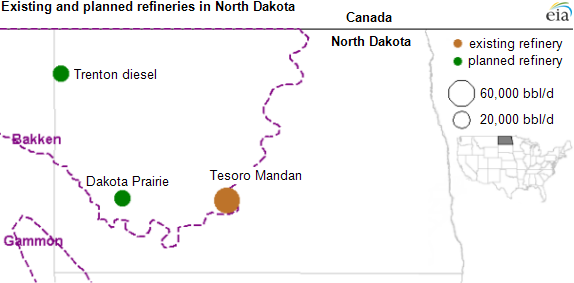
One of two new refineries being built in North Dakota broke ground this week. The 20,000-barrel-per-day (bbl/d) Dakota Prairie facility is scheduled to be built in 20 months. The impetus for the state's second and third refineries is the rapid increase in demand for diesel fuel and kerosene for trucking and industrial use within the state. Much of the increase in demand has been fueled by the boom in crude oil production from the new wells in the Bakken Formation in North Dakota's northwest corner. The demand for these middle distillates rose 80% in North Dakota from 2009 to 2012, providing the incentive to invest in local refineries.

North Dakota currently has one refinery, the Tesoro Mandan refinery located near Bismarck. This refinery has a capacity of 60,000 bbl/d, and its primary products include diesel fuel, jet fuel, heavy fuel oils, and liquefied petroleum gas. The two new refineries are smaller, both rated at 20,000 bbl/d capacity, and both will be fairly simple units that focus on creating the diesel and kerosene that are needed locally.

The Dakota Prairie refinery, which just broke ground, is a joint venture of MDU Resources Group and Calumet Specialty Products and will primarily make diesel fuel.

The Trenton Diesel Refinery is also planned, but no start-up date has been announced; it received an air quality permit from the North Dakota Department of Health in early 2012.

The Trenton Diesel Refinery, whose parent company is Dakota Oil Processing, is expected to cost $200 million to build and start-up. It will have an atmospheric distillation column, hydrotreater, naphtha stabilizer, and associated process equipment. According to Dakota Oil Processing's website, the primary product from the refinery will be light gas oil, a type of distillate. Other products will be naphtha, which may be used in the petrochemical industry or mixed into heavy crude oil to make it easier to transport; kerosene that the refinery plans to blend with the distillate pool to maximize distillate yield; atmospheric gas oil, a type of heavy distillate; and heavy fuel oil, which can be sold in the bunker fuel market.

Monday, March 18, 2013

SHORT TERM ENERGY OUTLOOK


Highlights

  • The weekly U.S. average regular gasoline retail price fell in early March for the first time since mid-December. The March 11 average was $3.71 per gallon, down $0.07 per gallon from February 25. EIA expects that lower crude oil prices will result in monthly average regular gasoline prices staying near the February average of $3.67 per gallon over the next few months, with the annual average regular gasoline retail price declining from $3.63 per gallon in 2012 to $3.55 per gallon in 2013 and $3.38 per gallon in 2014. Energy price forecasts are highly uncertain and the current values of futures and options contracts suggest that prices could differ significantly from this forecast.
  • EIA expects that the Brent crude oil spot price, which averaged $112 per barrel in 2012 and rose to $119 per barrel in early February 2013, will average $108 per barrel in 2013 and $101 per barrel in 2014. The projected discount of West Texas Intermediate (WTI) crude oil to Brent, which increased to a monthly average of more than $20 per barrel in February 2013, will average $16 per barrel in 2013 and $9 per barrel in 2014, as planned new pipeline capacity lowers the cost of moving mid-continent crude oil to the Gulf Coast refining centers.
  • U.S. crude oil production exceeded an average level of 7 million barrels per day (bbl/d) in November and December 2012, the highest volume since December 1992. EIA estimates that U.S. total crude oil production averaged 6.5 million barrels per day (bbl/d) in 2012, an increase of 0.8 million bbl/d from the previous year. Projected domestic crude oil production is expected to average 7.3 million bbl/d in 2013 and 7.9 million bbl/d in 2014.
  • Total U.S. liquid fuels consumption fell from 20.8 million bbl/d in 2005 to 18.6 million bbl/d in 2012. EIA expects total consumption to rise slightly over the next two years to an average of 18.7 million bbl/d in 2014, driven by increases in distillate fuel and liquefied petroleum gas consumption, with little change in gasoline and jet fuel consumption.
  • Natural gas working inventories ended February 2013 at an estimated 2.08 trillion cubic feet (Tcf), about 0.36 Tcf below the level at the same time a year ago but still 0.27 Tcf greater than the 5-year average (2008-12). EIA expects the Henry Hub natural gas spot price, which averaged $2.75 per million British thermal units (MMBtu) in 2012, will average $3.41 per MMBtu in 2013 and $3.63 per MMBtu in 2014. Current options and futures prices imply that the lower and upper bounds for the 95-percent confidence interval for June 2013 contracts at $2.79 per MMBtu and $4.67 per MMBtu, respectively.

Tuesday, January 10, 2012

Short Term Energy Outlook


Highlights

  • This edition of the Short‐Term Energy Outlook is the first to include forecasts for 2013.
·         EIA expects the price of West Texas Intermediate (WTI) crude oil to average about $100 per barrel in 2012, $5 p er barrel higher than the average price last year.  For 2013, EIA expects WTI prices to continue to rise, reaching $106 per barrel in the fourth quarter of next year.  EIA’s forecast assumes that U.S. real gross domestic product (GDP) grows by 1.8 percent in 2012 and 2.5 percent in 2013, while world real GDP (weighted by oil consumption) grows by 2.9 percent and 3.8 percent in 2012 and 2013, respectively.
·         The forecast of average household heating expenditures for all heating fuels has been lowered from th e first forecast for the current winter published in the October 2011 Outlook, primarily as a result of the warm first half of this heating season.  Average household heating oil expenditures are now expected to increase by 4 percent this winter heating season (October 1 to March 31) compared with last winter.  In contrast, natural gas and propane expenditures are projected to decline by 7 percent and 1 percent, respectively, and electricity expenditures are 2 percent lower than last winter’s levels.
·         EIA expects regular‐grade motor gasoline retail prices to average $3.48 per gallon in 2012, 4 cents per gallon lower than last year, and $3.55 per gallon in 2013.  During the April through September peak driving season each year, prices are forecast to average about 5 cents per gallon higher than the annual average.  There is regional variation in the forecast, with average expected prices on the West Coast about 25 cents per gallon above the national average during the April through September period.

·         Natural gas working inventories continue to set new record highs and ended December 2011 at an estimated 3.5 trillion cubic feet (Tcf), about 12 percent above the same time last year.  EIA’s average 2012 Henry Hub natural gas spot price forecast is $3.53 per million British thermal units (MMBtu), a decline of almost $0.50 per MMBtu from the 2011 average spot price.  EIA expects that Henry Hub spot prices will average $4.14 per MMBtu in 2013.
                                      
http://www.eia.gov/forecasts/steo/

ContactTancred Lidderdale      
tancred.lidderdale@eia.gov    phone: (202) 586-7321 

Wednesday, October 12, 2011

Short-Term Energy Outlook October 12, 2011 Release

Highlights


 EIA projects average household heating expenditures for natural gas, propane, and heating oil will increase by 3 percent, 7 percent, and 8 percent, respectively, this winter (October 1 to March 31) compared with last winter, while electricity heating expenditures fall by less than 1 percent. Average expenditures for households that heat with oil are forecast to be higher than in any previous winter.

 This forecast reflects higher prices for natural gas, propane, and heating oil, and slightly milder weather than last winter in much of the Nation contributing to lower consumption in many areas (see EIA Short Term Energy and Winter Fuels Outlook slideshow).

 According to the National Oceanic and Atmospheric Administration’s (NOAA) most recent projection of heating degree-days, the lower-48 States are forecast to be 2 percent warmer during the October through March winter heating season compared with last winter. However, heating degree-day projections vary widely among regions, with the West projected to be about 3 percent colder than last winter, and the South projected to be about 5 percent warmer.

 Forecast U.S. real gross domestic product (GDP) grows by 1.5 percent this year and by 1.8 percent next year, slightly lower than in last month’s Outlook. World oil-consumption-weighted real GDP grows by 3.0 percent and 3.5 percent in 2011 and 2012, respectively, compared with 3.1 percent and 3.8 percent in the last Outlook. EIA expects the U.S. average refiner acquisition cost of crude oil to average $99 per barrel in 2011 and $98 per barrel in 2012, compared with $100 per barrel and $103 per barrel, respectively, in the previous Outlook.

 Natural gas working inventories ended September 2011 at 3.4 trillion cubic feet (Tcf), about 2.6 percent, or 91 billion cubic feet (Bcf), below the 2010 end-of-September level. EIA expects that working natural gas inventories will approach last year’s high levels by the end the injection season. The projected Henry Hub natural gas spot price averages $4.15 per million British thermal units (MMBtu) in 2011, $0.24 per MMBtu lower than the 2010 average. EIA expects the rate of growth in domestic natural gas production to slow in 2012, with the Henry Hub spot price averaging $4.32 per MMBtu.

Contact:

Tancred Lidderdale
tancred.lidderdale@eia.gov
phone: (202) 586-7321

Thursday, June 23, 2011

Chinese Oil Demand 101: The Role of Electricity

Despite recent decreases in crude oil prices and concern over the pace of economic growth in Organisation for Economic Co-operation and Development (OECD) countries, supply and demand fundamentals underlying the oil market remain strong. Far from reducing their expectations of global oil demand growth for 2011, the U.S. Energy Information Administration's (EIA) Short-Term Energy Outlook and other forecasters have recently raised their demand projections. EIA is currently projecting global oil demand to average 88.4 million barrels per day (bbl/d) in 2011, 1.7 million bbl/d higher than in 2010. Of that increment, China alone is expected to account for some 700 thousand bbl/d. Why such strong growth, and why the upward revisions, given that most forecasters are becoming, if anything, slightly less optimistic about China's economy?

Friday, April 15, 2011

Short Term Energy Outlook from EIA; April 12, 2011

  • West Texas Intermediate (WTI) crude oil spot prices averaged $89 per barrel in February and $103 per barrel in March. The WTI price has continued to rise in recent days, reaching $112 on April 8. Crude oil prices are currently at their highest level since 2008. EIA expects oil markets to continue to tighten over the next two years given expected robust growth in world oil demand and slow growth in supply from non-Organization of the Petroleum Exporting Countries (non-OPEC) countries. These conditions result in an expected drawdown of global petroleum stocks and a call for increasing production from OPEC member countries, which will reduce surplus crude oil production capacity at a time when the disruption of crude oil exports from Libya and continuing unrest in other Middle East and North African (MENA) countries already highlight significant supply risks. Projected WTI prices average $106 in 2011 and $114 per barrel in 2012, increases of $5 per barrel and $9 per barrel, respectively, from last month's Outlook.

  • The rise in crude oil prices is reflected in higher petroleum product prices. EIA projects that the retail price of regular-grade motor gasoline will average $3.86 per gallon during this summer’s driving season (the period between April 1 and September 30), up from $2.76 per gallon last summer. EIA forecasts the annual average regular retail gasoline price will increase from $2.78 per gallon in 2010 to $3.70 per gallon in 2011 and to $3.80 per gallon in 2012. Current market prices of futures and options contracts for gasoline suggest a 33-percent probability that the national monthly average retail price for regular gasoline could exceed $4.00 per gallon during July 2011.

  • Natural gas working inventories ended March 2011 at 1.6 trillion cubic feet (Tcf), slightly below the 2010 end-of-March level. EIA expects that working gas inventories will remain relatively high throughout 2011. The projected Henry Hub natural gas spot price averages $4.10 per million Btu (MMBtu) in 2011, $0.29 per MMBtu lower than the 2010 average. EIA expects the natural gas market to begin to tighten in 2012, with the Henry Hub spot price increasing to an average of $4.55 per MMBtu.

Wednesday, October 13, 2010

Short-Term Energy and Winter Fuels Outlook

To see details of this forecast update, go to the following World Wide Web site on the Internet:
http://www.eia.doe.gov/emeu/steo/pub/contents.html

Highlights

  • EIA projects average household expenditures for space-heating fuels will total $986 this winter (October 1 to March 31), an increase of $24, or 2.5 percent, from last winter.  EIA projects higher expenditures in all fuels except electricity, where expenditures decline by 2 percent.  This forecast reflects moderately higher prices for all the fuels, although slightly milder weather than last winter for much of the Nation should contribute to lower consumption in many areas.

  • According to the National Oceanic and Atmospheric Administration’s (NOAA) most recent projection of heating degree-days, the lower-48 states are forecast to be 3 percent warmer during the October through March winter heating season compared with last winter and 1 percent warmer than the 30-year average (1971-2000).  However, heating degree-day projections vary widely between regions.  For example, the Northeast, the principal market for heating oil, is projected to be about 5 percent colder than last winter, while the South is projected to be about 15 percent warmer. 

  • EIA expects the price of West Texas Intermediate (WTI) crude oil to average about $80 per barrel this winter, a $2.50-per-barrel increase over last winter.  The forecast for average WTI prices rises gradually to $85 per barrel by the fourth quarter of 2011 as U.S. and global economic conditions improve.  EIA’s forecast assumes U.S. gross domestic product (GDP) grows by 2.6 percent in 2010 and 2.1 percent in 2011, while world oil-consumption-weighted GDP grows by 3.8 percent and 3.3 percent, respectively, in 2010 and 2011.

  • Projected natural gas inventories reach more than 3.7 trillion cubic feet (Tcf) at the end of this year’s injection season (October 31).  This projected volume will be about 3 percent lower than last year’s record-setting level but will still represent the second highest underground storage level on record for the month of October.  The projected Henry Hub annual average spot price increases from $3.95 per million Btu (MMBtu) in 2009 to $4.47 in 2010 and $4.58 in 2011.  

Tuesday, March 9, 2010

EIA Short Term Energy Outlook -- March 09, 2010 Release

To see details of this forecast update, go to the following World Wide Web site on the Internet:
http://www.eia.doe.gov/emeu/steo/pub/contents.html

Highlights

  • Although spot crude oil prices continue to fluctuate on a daily basis, EIA’s projections for West Texas Intermediate (WTI) crude oil spot prices have remained relatively stable over the last 4 Outlooks. EIA expects WTI prices to average above $80 per barrel this spring, rising to an average of about $82 per barrel by the end of the year and to $85 per barrel by the end of 2011.
  • Projected economic growth this year is higher in this forecast, with U.S. real gross domestic product (GDP) growing by 2.8 percent and world oil-consumption-weighted real GDP growing by 3.4 percent, compared with 2.3 percent and 2.7 percent growth, respectively, in last month’s Outlook. The 2011 forecast for real GDP growth is relatively unchanged at 2.6 percent and 3.5 percent for the United States and the world, respectively.
  •  EIA forecasts that the annual average regular grade retail gasoline price will increase from $2.35 per gallon in 2009 to $2.84 in 2010 and to $2.96 in 2011 because of the projected rising crude oil prices. Average U.S. pump prices likely will exceed $3 per gallon at times during the forthcoming spring and summer driving season. Projected annual average retail diesel fuel prices are $2.96 and $3.14 per gallon, respectively, in 2010 and 2011.
  • EIA expects this year’s annual average natural gas Henry Hub spot price to be $5.17 per million Btu (MMBtu), a $1.22-per-MMBtu increase over the 2009 average. EIA projects price increases to continue in 2011, averaging $5.65 per MMBtu for the year. Projected working gas inventories end the first quarter of 2010 at about 1,550 billion cubic feet (Bcf) compared with 1,644 Bcf in the previous Outlook because of colder-than-normal weather in February. Natural-gas-weighted heating degree-days were nearly 11 percent above the 30-year norm last month.
  • The annual average residential electricity price changes only slightly over the forecast period, averaging 11.5 cents per kilowatthour (kWh) in both 2009 and 2010, and then rising to 11.6 cents per kWh in 2011.
  • Carbon dioxide (CO2) emissions from fossil fuels, which declined by 6.4 percent in 2009, increase by 1.5 percent and 1.2 percent in 2010 and 2011, respectively, in the forecast as economic growth fuels higher energy consumption.

Monday, December 14, 2009

EIA Predicts no demand growth for fossil fuels in US

Government energy forecasters see U.S. demand for petroleum fuels seeing no growth through the year 2035 in the absence of new policies mandating lower greenhouse gas (GHG) levels or higher efficiencies, the Energy Information Administration (EIA) said Monday.
Part of the forecast stems from talks in Copenhagen, Denmark, among international leaders to devise a global plan to cut GHG emissions. The projections suggest the implications for energy use in the event that not enough action is taken to reduce levels of gases widely held responsible for global warming.
The EIA now sees growth in liquid fuels demand through 2035 coming from biofuel production, with consumption of petroleum fuels holding essentially flat, according to a report from Dow Jones Newswires.
Ethanol production is forecast to grow to about 28 billion gallons a year by 2035, up from around 10 billion gal/year currently. That level falls below the 36 billion gal/year mandate for all biofuels by 2022. Failure to meet the mandates is due largely to the expected slow growth of advanced biofuel technologies, the report said.
Total U.S. energy use is forecast to grow 14% from 2008 levels by 2035, including a 5% decline from the economic recession. Fossil fuels are seen providing 78% of U.S. energy needs by 2035, down from the current 84%, due to efficiency gains.
Assuming OPEC holds onto a 40% share of the oil market, U.S. oil prices are expected to rise to around $133/bbl in 2008 dollars by 2035, pressured higher by global demand growth.